Dear Reader,
In a single five-day stretch this past January, three of the best-known companies in America — Amazon, Nike, and Home Depot — cut 17,575 jobs between them.
In a single five-day stretch this past January
17,575 jobs
Amazon. Nike. Home Depot.
January 2026
The financial press needed a name for it. They settled on “Automation Week.”
It wasn’t a recession. Corporate profits were near record highs.
It wasn’t offshoring. The work didn’t move to another country.
The work simply stopped requiring people.
And buried in that week’s coverage was a detail almost everyone missed:
Every time one of those announcements crossed the wire… the company’s stock went up.
It hasn’t stopped since.
Salesforce’s chief executive stood on an earnings call — the most scripted, lawyer-checked stage in American business — and said, word for word: “My message to CEOs right now is that we are the last generation to manage only humans.”
“My message to CEOs right now is that we are the last generation to manage only humans.”
— Salesforce chief executive, on an earnings call
Amazon alone has eliminated more than 30,000 corporate positions.
Klarna has cut its workforce roughly in half.
Oracle has quietly shed thousands more. Different industries. Different businesses. The same announcement — and the same market reaction, within minutes of the wire.
The same announcement — and the same market reaction
Different industries. Different businesses. The same announcement.
And while for the average American this is a terrifying reality…
Understanding what’s happening also gives regular investors the chance to position themselves for one of the most significant wealth creation events of our generation.
Because the money from those jobs isn’t vanishing. It’s changing hands.
The paychecks stop. The work doesn’t.
It goes to the machines now. And machines don’t work for free.
Somebody owns them. Every dollar that used to land in a worker’s bank account starts landing in the owner’s.
This year, American employers will pay out roughly $13 trillion in wages and salaries.
Your paycheck is part of that money.
And the transfer has quietly begun, at a speed no one alive has ever seen. Out of America’s paychecks. Into the accounts of the few companies that own the machines.
This year, American employers will pay out roughly $13 trillion in wages and salaries.
$13 trillion
I know where it’s going. Not roughly — precisely.
Because this exact transfer has happened three times before in American history. And every time, it has obeyed a single, unwritten law — a law with a strange name, a 236-year record, and a habit of making a small number of ordinary Americans astonishingly rich.
A Rochester cab driver who understood it turned $1,000 into more than $2 million.
An office gofer — a man whose job was fetching his boss’s dry cleaning — became a millionaire because of it.
So did a masseuse.
A Rochester cab driver who understood it
An office gofer. A masseuse. Ordinary Americans on the collecting side.
That door is opening again right now — wider, I believe, than at any moment since 1790. And history says the ordinary people who walk through it early get the chance at the kind of gains that turn four-figure stakes into seven-figure fortunes.
In the next few minutes, I’m going to name that law for you. I’m going to take you to the freezing December morning in 1790 when it first fired on American soil. And I’m going to prove, with brokerage statements and records, exactly what it has paid the people standing on its collecting side.
Then I’ll show you something that has never happened in the law’s 236-year history.
This past May, the founder of a quiet company most Americans have never heard of put two words into an official press release — two words that identify his company, in writing, as the destination for the money now leaving America’s paychecks. The closest thing to a signed confession this story has.
And I’ll show you why the clock on all of it is measured in weeks. Not years.
If you draw a paycheck, what follows may be the most important thing you read this decade.
And if you’re retired, living on the savings a lifetime of paychecks built, it matters just as much. Savings can be moved to the collecting side too.
Now — before I take you any further, you deserve to know exactly who’s talking. Because I’m about to make some enormous claims, and you should know whose word you’re weighing.
My name is Dylan Jovine.

Founder, Behind the Markets
I didn’t grow up rich. I grew up standing in line for food stamps in Queens.
Like any dirt-poor kid in New York desperate to change his fortune, I set my sights on Wall Street.
And like every “nobody” trying to make it on The Street, I was laughed out of every Ivy-League-filled room.
But one man took a chance on me — because he’d been an outsider himself, before saving New York City from bankruptcy in the 1970s and building his own respected firm.
I wasn’t going to blow my chance. By age 24, I had built my own firm at 100 Wall Street — one of the youngest broker-dealers in history.

Since then, I’ve made one call after another that landed me on television and even in the White House.
More than two years before Lehman Brothers collapsed, I issued a public warning that the housing market was a ticking time bomb. “The market has no place else to go but down. It’s not a question of ‘if’ it’s a question of ‘when.’”
“The market has no place else to go but down. It’s not a question of ‘if’ it’s a question of ‘when.’”
— Dylan Jovine, a full year before Lehman Brothers collapsed
That call got me invited to meet privately with President George W. Bush and Vice President Dick Cheney.
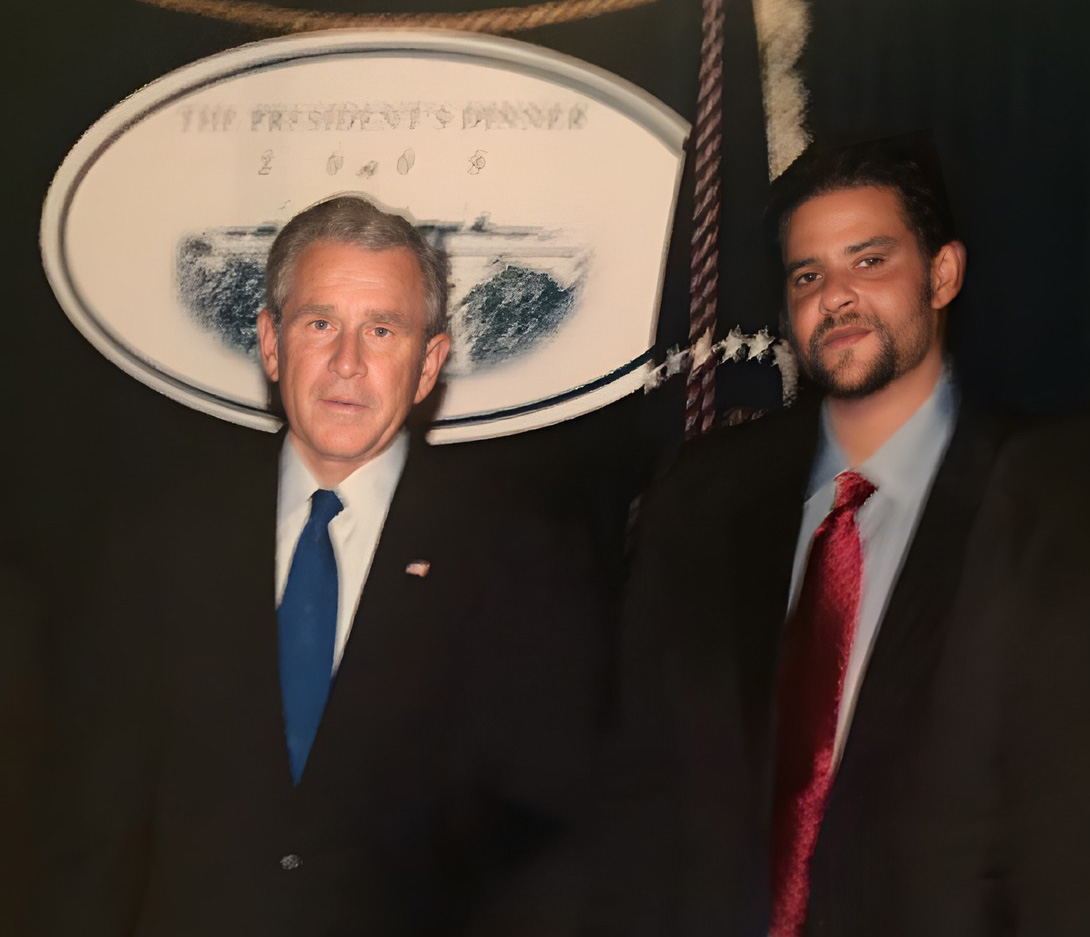
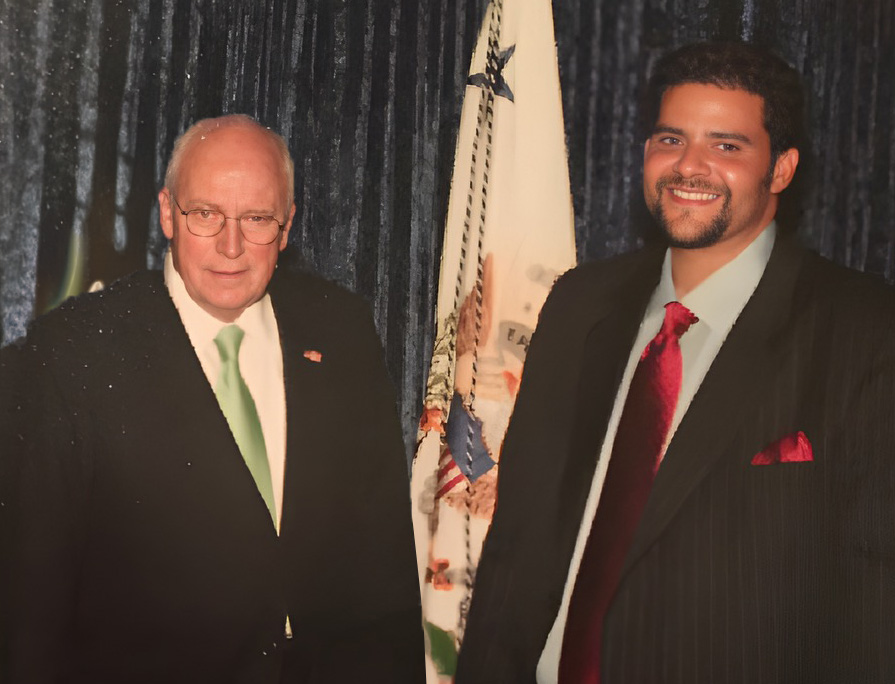
When the Dow dropped 54%, I went on FOX Business calling the bottom — telling anyone who would listen that a stock market at 6,500 is like walking into a dealership where everything is marked 90% off.
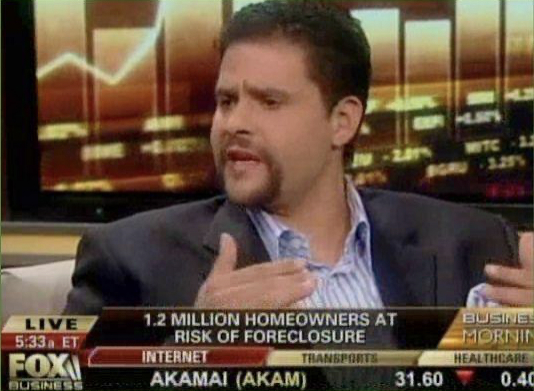
Anyone who heeded that call had the chance to book gains like 459% on AutoNation…
$5,000 into $27,950 at 459%
Source: Yahoo Finance, daily closing prices.
646% on American Express…
$5,000 into $37,300 at 646%
Source: Yahoo Finance, daily closing prices.
And 700% on Starbucks.
$5,000 into $40,000 at 700%
Source: Yahoo Finance, daily closing prices.
In March 2020, I called the bottom of the Covid crash almost to the exact day. “FACT: When we get to the other side of this, the market will have a ‘SNAP-BACK’ rally because prices and interest rates are so cheap.”
“FACT: When we get to the other side of this, the market will have a ‘SNAP-BACK’ rally because prices and interest rates are so cheap.”
— Dylan Jovine, calling the Covid bottom almost to the exact day
The result: 102% on PagSeguro.
$5,000 into $10,100 at 102%
Source: Yahoo Finance, daily closing prices.
124% on DraftKings.
$5,000 into $11,200 at 124%
Source: Yahoo Finance, daily closing prices.
155% on Floor & Decor.
$5,000 into $12,750 at 155%
Source: Yahoo Finance, daily closing prices.
195% on Scotts Miracle-Gro.
$5,000 into $14,750 at 195%
Source: Yahoo Finance, daily closing prices.
Three historic crashes. Three documented calls. Today, more than 500,000 readers across 184 countries follow my research.
But here is the call that matters most for what I’m about to show you.
In 2021, I watched Washington spend money like the bill would never come due. I told my readers the dollar was in trouble — and to buy gold at $1,800 an ounce. “The world is entering a new cycle of war. Russia and China are trying to flip the international script just like Germany did in 1914.”
Wall Street laughed. Awash in cheap money, they called gold a relic.
But I know history. Every time paper money inflates, gold answers.
Today gold trades over $4,000 — after touching an all-time high near $5,600 this January.
Line plots daily closes, July 2021 – August 2026; the $5,586 all-time high (Jan 29, 2026) was an intraday print, marked at the closing high. Recommended at $1,800; $4,539 today, +152%. Source: Yahoo Finance / COMEX front-month.
And one more.
Years ago, I told my readers to buy an unknown tech company called Palantir around $7 a share.
Wall Street saw another software seller.
I didn’t see a software company. I saw a national weapon — the data platform the U.S. military, the spy agencies, and the CIA physically could not operate without.
It ran as high as $207.
Over 2,800%.
A $5,000 investment could have grown as high as $145,000.
A $5,000 investment could have grown as high as $145,000.
Source: Yahoo Finance, daily closing prices.
One more thing you should know about me:
After I publicly exposed the link between American technology and China’s military buildout, the Chinese Communist Party sent a woman to “talk to me” about my statements.
I reported the contact to federal authorities immediately. And I kept publishing.
The stock at the center of that warning — Micron Technology — has since catapulted 677%.
Source: Yahoo Finance, daily closing prices, September 2022 – August 2026.
We don’t catch the full move on every trade. But my readers have reported some remarkable outcomes of their own.
“You are the best and most accurate investing advisor I have ever used. I find you to be an honest, kind, and trustworthy adviser — and far above all other services in integrity.”
Rod Gray, Reno, NV
“I’ve been following Dylan’s recommendations for almost 20 years. His best idea made me almost 7 times my original investment.”
Dr. Robert M.
“That was the fastest money I have ever made in my life. You recommended Loxo Friday morning and it was taken over Monday. Wow.”
Scott S., Pasadena, CA
My refusal to back down is why two U.S. Congressmen asked to meet me off the record on March 2nd, just 2 days after the bombs began falling on Iran again.

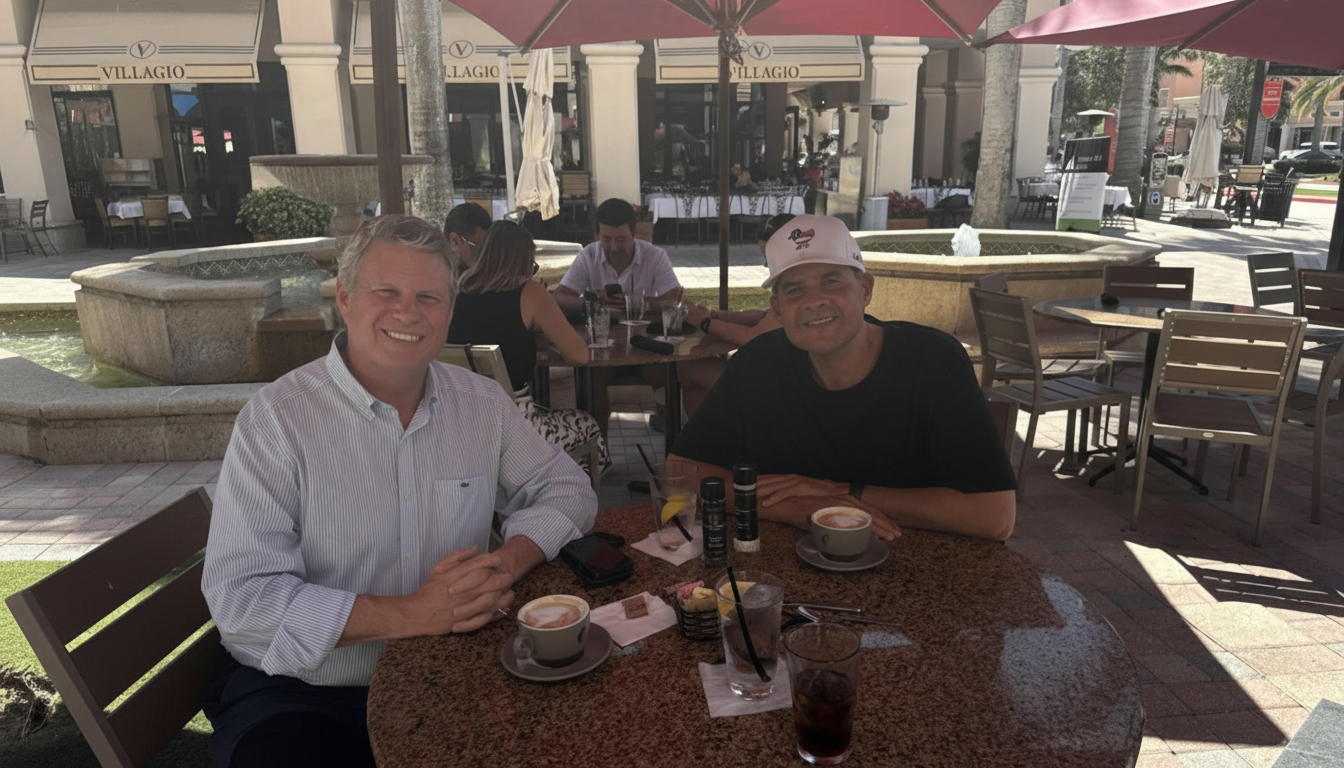
It’s why I was invited to The Breakers in Palm Beach to sit down privately with Donald Trump Jr.
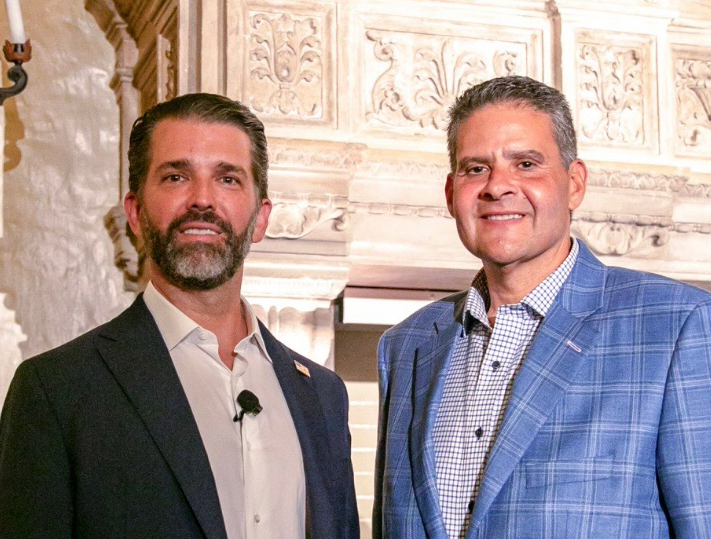
I don’t tell you any of that to impress you. I tell you because the claim in this letter is the biggest one of my career — and you deserve to weigh it against that record.
The Three Laws Every Investor Knows… and the One Nobody Does
It starts with three laws you probably already know… and the one law nobody does.
In 1965, an engineer named Gordon Moore noticed that the number of transistors on a chip kept doubling on a steady clock.
His observation became Moore’s Law — and the investors who grasped it early owned the semiconductor age. In fact, Moore’s company – Intel – would have turned a single $23.50 share in 1971 into more than $160,000 today.

Intel Free Press / Wikimedia Commons, CC BY-SA 2.0
In 1936, an aeronautical engineer named Theodore Wright documented that every time aircraft production doubled, the cost per plane fell by a predictable fraction.
Wright’s Law — and the industrialists who grasped it owned American manufacturing.
It’s why $1,000 in Boeing from their debut would now be worth $946,000.
Years later, Robert Metcalfe observed that a network’s value grows with the square of its connections. Metcalfe’s Law — and the investors who grasped it owned the internet.
In fact, Metcalfe’s work led to Cisco building the “plumbing system” of the Internet. $1,000 in Cisco at IPO would now be worth $1.35 million… plus a $26,000 a year dividend.
Three laws. Three generations of fortunes.
$946,000Boeing, from debut
$1.35 millionCisco, at IPO — plus $26,000/yr dividend
All three are children.
Long-run returns to the stated start dates; Cisco from IPO; dividends noted where included.
Three laws. Three generations of fortunes. If you’ve spent any time around markets, you’ve heard at least one of them quoted like scripture.
But all three are children.
They descend from an older law — one that was already operating before the light bulb, before the telegraph, before the stock market itself.
It’s named after a man the British called a traitor and an American president called a father.
The Man Who Smuggled a Factory
In 1789, a 21-year-old mill apprentice from Belper, England, committed what his country considered a form of treason.
He didn’t steal documents.
Britain had thought of that.
It was illegal to export drawings of textile machinery — and illegal for the men who understood the machines to leave the country at all.
Ship inspectors searched luggage for blueprints.
So Samuel Slater carried nothing.
He memorized an entire factory.
Every gear ratio. Every roller.
Every adjustment that made Richard Arkwright’s water-powered spinning frames actually run.
Then he dressed as a farm laborer, boarded a ship, and sailed for New York with the most valuable industrial secret on Earth stored in his brain.
The people of Belper found out what he’d done.
They gave him a nickname that survives in England to this day:
Slater the Traitor.
Now — here’s the part of the story that should sound eerily familiar.
Waiting in Rhode Island was Moses Brown, one of the richest merchants in America.
Brown had already bought a 32-spindle spinning frame built to Arkwright’s pattern.
He owned the hardware.
He could not make it turn.
America had the machine. America was missing the knowledge.
Slater wrote to Brown, examined the dead machinery, and rebuilt it from memory.
And on a freezing December morning in 1790, in that converted mill on the Blackstone River, the 22-year-old opened a sluice gate and let the water hit the wheel.

Photo: Bestbudbrian / Wikimedia Commons, CC BY-SA 3.0
The spindles started spinning cotton into thread — work that had belonged, for all of human history, to human hands.
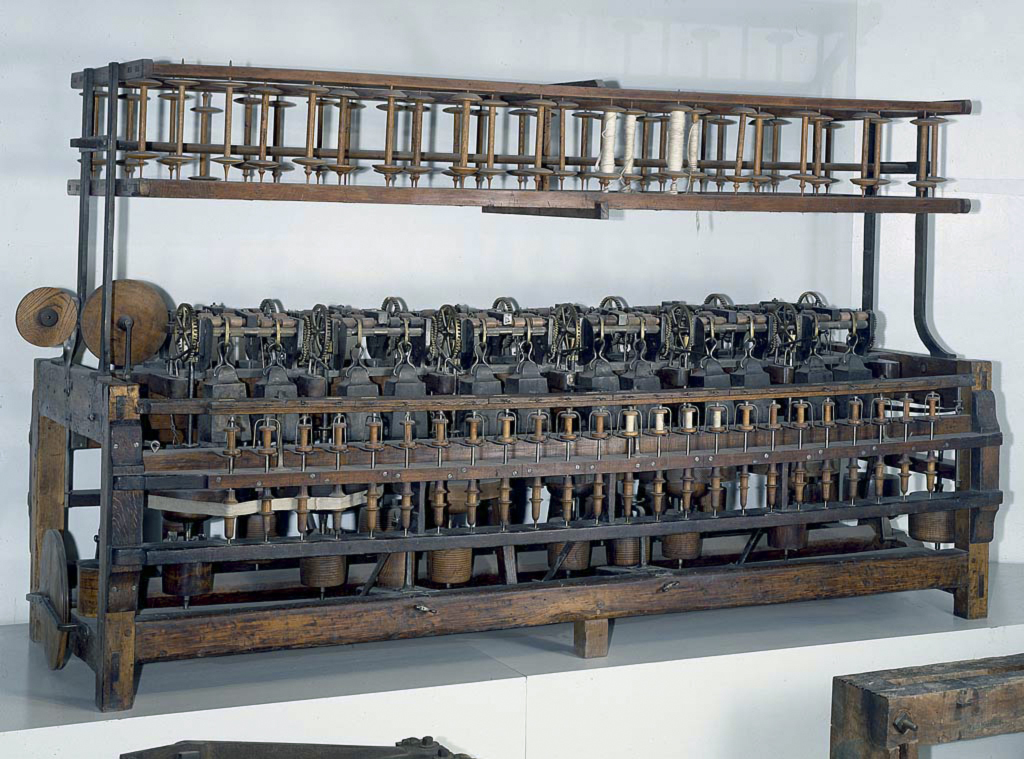
Smithsonian National Museum of American History via Wikimedia Commons, public domain
This is the morning I promised to bring you to.
Because something changed in Pawtucket that day that has never changed back.
For thousands of years, spinning thread was wage work — done in cottages, paid by the piece, one pair of hands at a time.
From that morning forward, the same work was done by machinery… and the money that used to land in the spinners’ pockets began landing somewhere else.
In the pockets of the men who owned the mill.
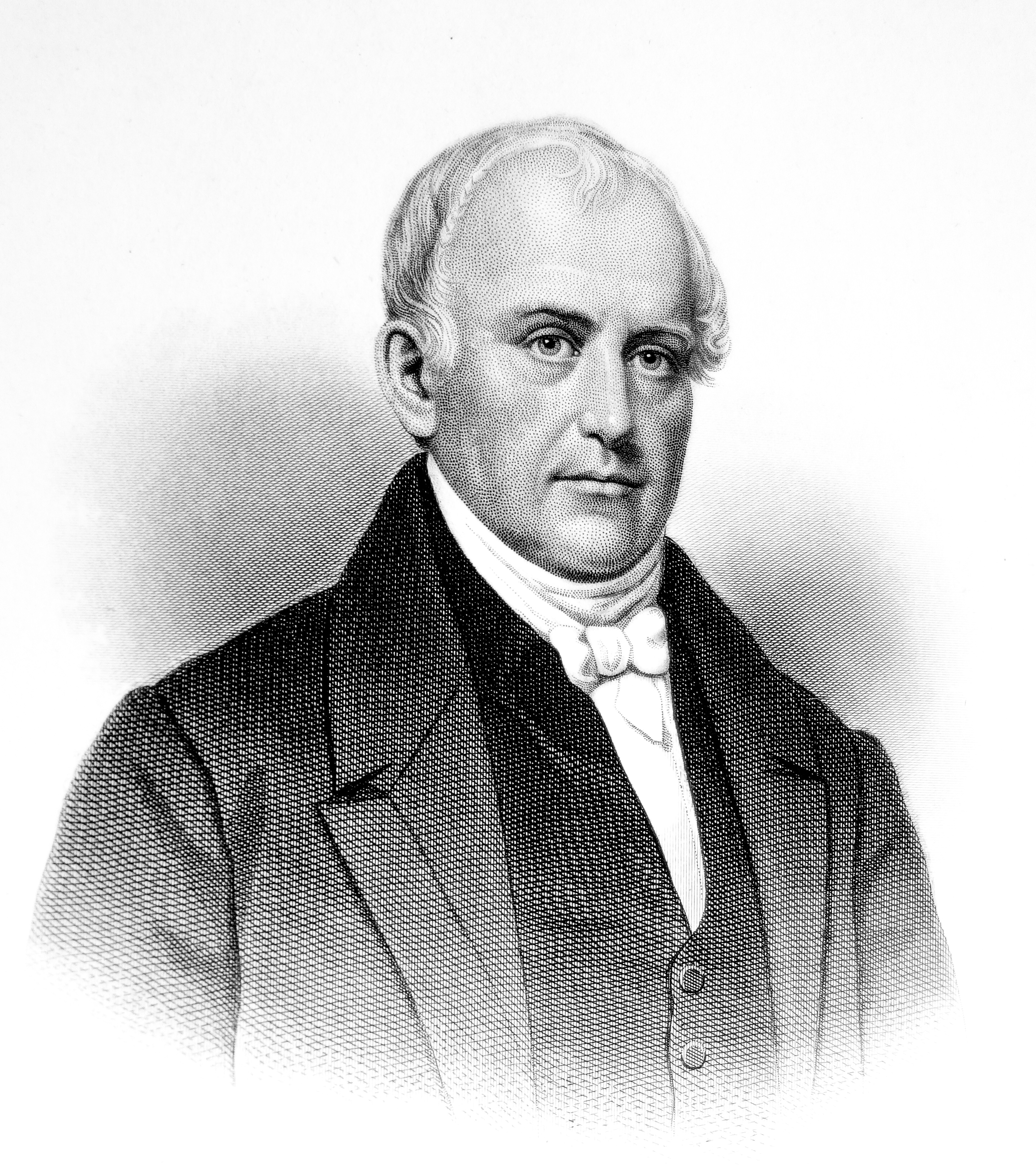
The Biographical Cyclopedia of Representative Men of Rhode Island, 1881 — public domain
Samuel Slater arrived in America in disguise, carrying almost nothing.
He died in 1835 one of the wealthiest men in the country.
Andrew Jackson — the sitting President of the United States — traveled to see his operation and gave him the title American history still uses:
The Father of the American Industrial Revolution.
The workers called him a traitor. The President called him a father.
Both were describing the same man. The only difference was which side of the machinery they stood on.
Before the machinery Samuel Slater brought to America, every thread in every shirt was spun by hand, one at a time.
It took four to eight spinners, working full time, to keep a single weaver supplied.
Spinning wasn’t a job. It was what women did with every hour they weren’t cooking, cleaning, or raising children — their whole lives, for almost nothing.
We still have the word for it. An unmarried woman was a spinster, because spinning was what she did.
Then the machines came. One mill did the work of hundreds of pairs of hands.
Today you can walk into any Walmart in America and buy a shirt for under ten dollars.
That’s the good news, and it’s real.
Here’s the part nobody mentions.
All those hands stopped getting paid — and the money didn’t vanish with them. It moved.
To the men who owned the mill.
The Law, in One Sentence
Here is the law:
When a machine learns to do a man’s work, the man’s wages don’t vanish. They move — into the accounts of whoever owns the machine.
When a machine learns to do a man’s work, the man’s wages don’t vanish. They move — into the accounts of whoever owns the machine.
I call it Slater’s Law.
When Slater’s wheel first turned in December 1790, the New York Stock Exchange did not exist.
In fact, this law doesn’t just precede the American stock market – it built it.
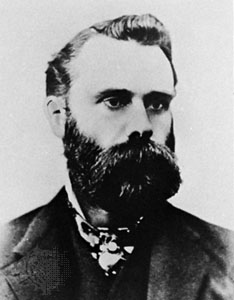
The Industrial Revolution so completely remade American enterprise — throwing off so many new manufacturing giants — that in 1896 Charles Dow gathered up the biggest of them, in steel and sugar and lead and rubber and electricity, and founded the Dow Jones Industrial Average.
Slater’s Law is older than the American stock market itself.
Every share ever traded has traded inside its jurisdiction.
We’ve seen this Law transform society three times in America’s history.
The first firing mechanized the nation’s handwork — spinning, weaving, making — and built the mill fortunes.
The second rolled off the assembly lines beginning in 1913 and industrialized everything from the factory floor to the elevator shaft.
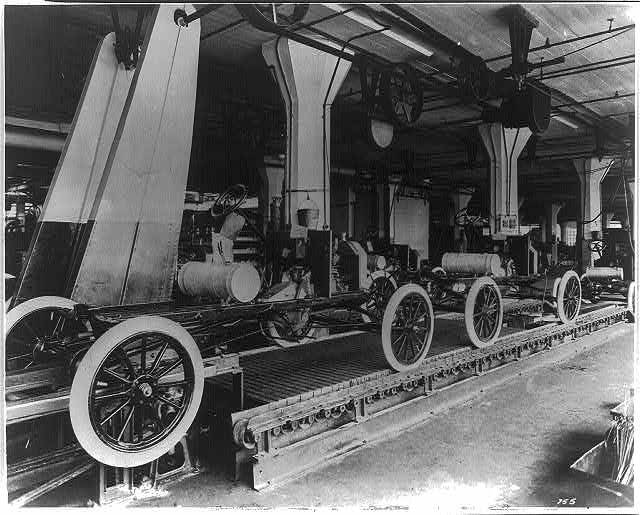
The third arrived through the office door in the second half of the last century — the copier, the computer, the software.
Each time, the people on the manufacturing side – the people and investors behind the machines – made a fortune.
I believe the fourth will be remembered as the single biggest wealth-building chance of your lifetime.
Each time, it pulled off the largest quiet transfer of money in its era — out of paychecks, into the hands of owners.
And each time, the door was standing wide open for ordinary people to walk through.
We’ve seen this Law transform society three times in America’s history.
A few did.
Their stories are a matter of public record — and they are the reason I’m writing to you today…
And why I’m going to share a single investment you can make, today, to put yourself on the right side of this $13 trillion revolution… for the chance at gains that could turn a $1,000 stake… into upwards of $100,000.
Let me give you a glimpse of what’s possible.
What the Cab Driver Knew
In 1942, a cab driver in Rochester, New York, walked into a broker’s office and put $1,000 into a struggling local photographic-paper company called Haloid.
For most of two decades, that looked like a mistake.
Haloid was small, unglamorous, and stuck in the shadow of its neighbor, Eastman Kodak.
Then, in 1959, Haloid shipped a 648-pound machine called the 914 — the first practical plain-paper office copier.
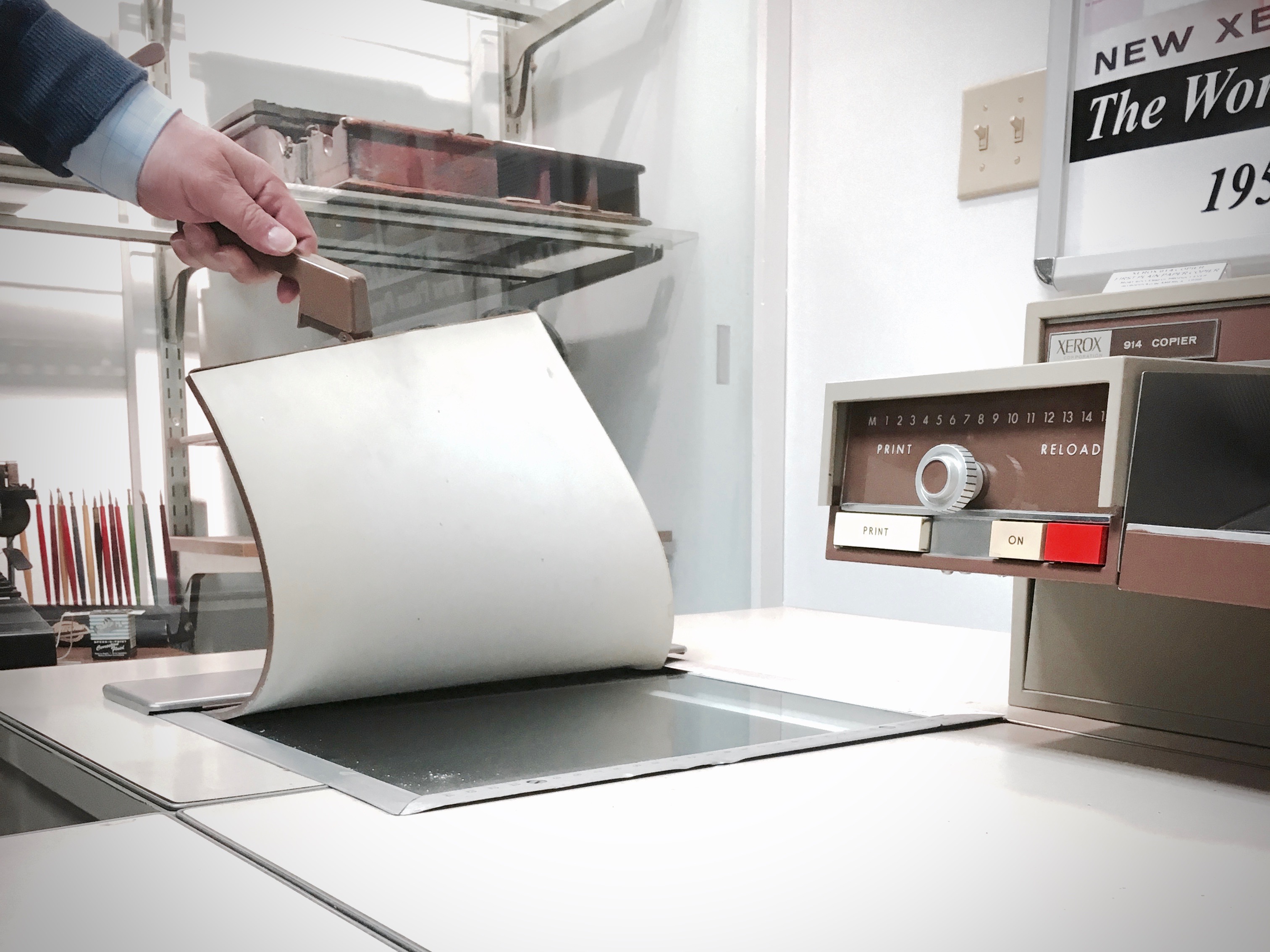
Photo: Marcin Wichary / CC BY 2.0
The company renamed itself after its own invention.
Xerox.
Understand what that machine actually replaced.
In 1959, “making a copy” meant a human being — almost always a woman in a secretarial pool — retyping a document, page by page, or wrestling with carbon paper. Copying was wage work.

Library of Congress
The 914 did that work at the push of a button.
Fortune magazine later called it the most successful product ever marketed in America.
And Slater’s Law activated.
The copying wages moved — out of the typing floors, into Xerox’s revenue line.
By 1966, Time magazine reported the stock had multiplied 50 times over in just six years.
Six years.
$1,000 into $50,000 — multiplied fifty times over in six years
Source: Time magazine, 1966, reporting Xerox stock had multiplied fifty times over in six years. Growth of a hypothetical $1,000 stake, 1960 – 1966. Past performance does not guarantee future results.
Rochester filled up with quiet millionaires who had done nothing more than own a piece of the machine.
And that cab driver?
Thirty years after his $1,000 purchase, his stake was worth more than $2 million.
He never wrote a line of code.
He never invented anything. He never managed a dime of anyone else’s money.
An ordinary working man, on the collecting side of Slater’s Law, growing wealthy off the very force that was erasing other men’s paychecks.
That picture is why I’m speaking to you today.
Jobs will be wiped out. It’s happening now.
But the kind of windfall that could turn $1,000 into $100,000… $946,000… even $2 million or more is available to you right now.
However, before we get into the details of the one investment I am urging every investor to make today…
Because the law was only warming up — and to understand how subtly, and quickly, it can transform the economy… we have to take a look at an old U.S. Census.
In 1950, the U.S. Census listed 270 distinct occupations.
Of those 270, exactly one has since been erased — completely, one hundred percent, automated out of existence.
The elevator operator.
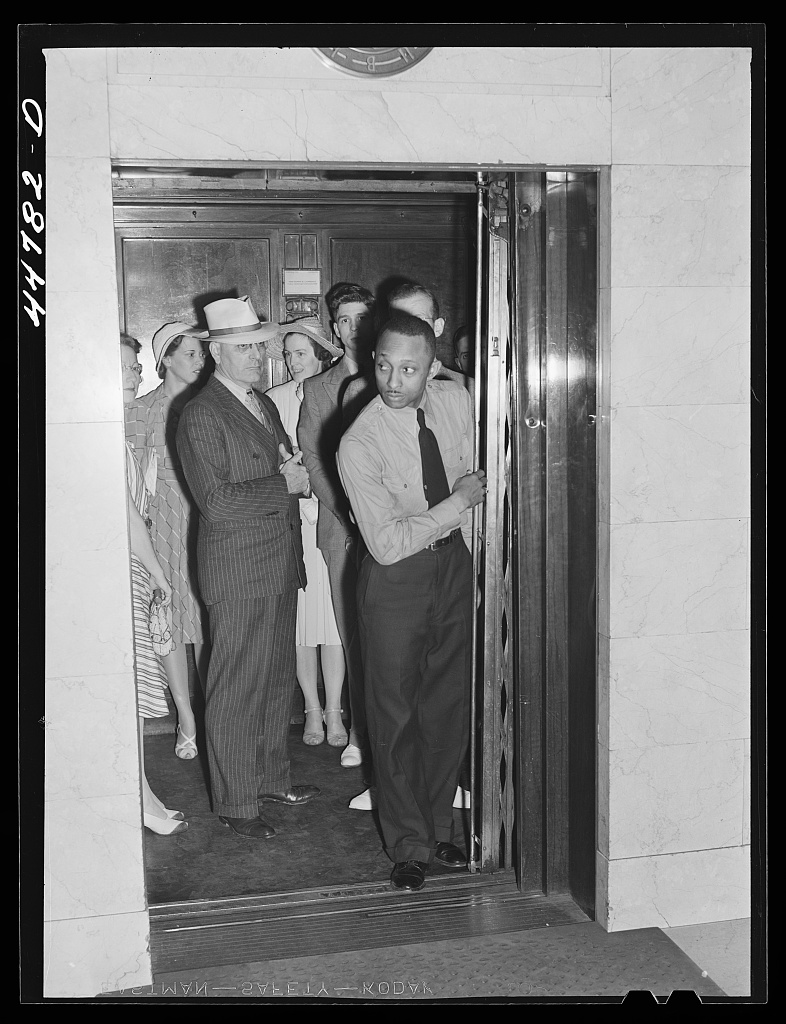
FSA/OWI, Library of Congress
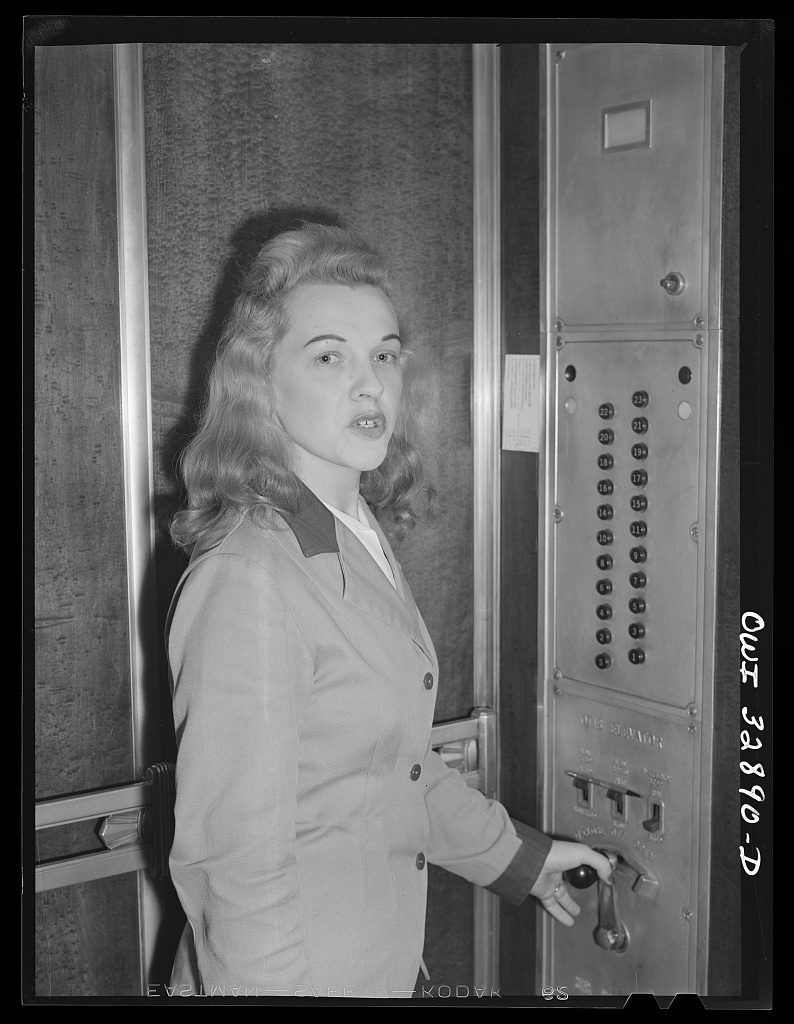
OWI, Library of Congress
At the profession’s peak, more than 90,000 Americans earned a living running elevators.
It took the better part of 75 years — electric motors, push buttons, safety brakes, and a public-relations campaign to convince frightened passengers to ride alone — to fully erase a single American occupation from existence.
The Only Job America Ever Completely Erased
90,000+ Americans once ran elevators. It took 75 years to erase the job.
Which raises the question that unlocks this entire letter: what happened to the other 269?
Because here is the part that took me the longest to see — and once you see it, you can never unsee it.
Slater’s Law almost never kills a job outright.
Instead, the law guts the job and leaves the name standing.
The occupation survives on paper. The Census keeps printing the title, year after year.
What disappears is everything inside it:
The machine takes the routine core of the work… the headcount collapses… the ordinary middle-class wage evaporates… and a small band of survivors retreats upmarket to serve whoever will still pay a premium for the human touch.
The government’s statistical tables go right on counting a living occupation — long after the wages that made it a livelihood have moved to the other side of the ledger.
There is never an obituary.
No headline has ever read “Bookkeeping Ends Today.”
And yet, over the last 12 years, 344,000 bookkeeping jobs have quietly been vaporized…
The government didn’t even see it coming.
In 2012 the Labor Department projected this profession would grow.
Meaning the job pool has actually shrunk by nearly a third in size.
Here’s how the Labor Department explains it now, in its own words: software automated many of their tasks, so the same amount of work gets done with fewer employees.
Intuit — the company that sold the software — traded around $59 a share in 2012. Last summer it touched $786.57.
344,000 jobs gone – and a stock that roared more than 1,200% over the exact same time.
That money didn’t evaporate. It moved.
That money didn’t evaporate. It moved. The title outlives the paycheck — which is exactly why the transfer stays invisible while it happens.
Watch it work on the largest near-miss of them all.
As late as 1950, roughly 350,000 women worked the telephone switchboards — about one of every 13 employed women in America.
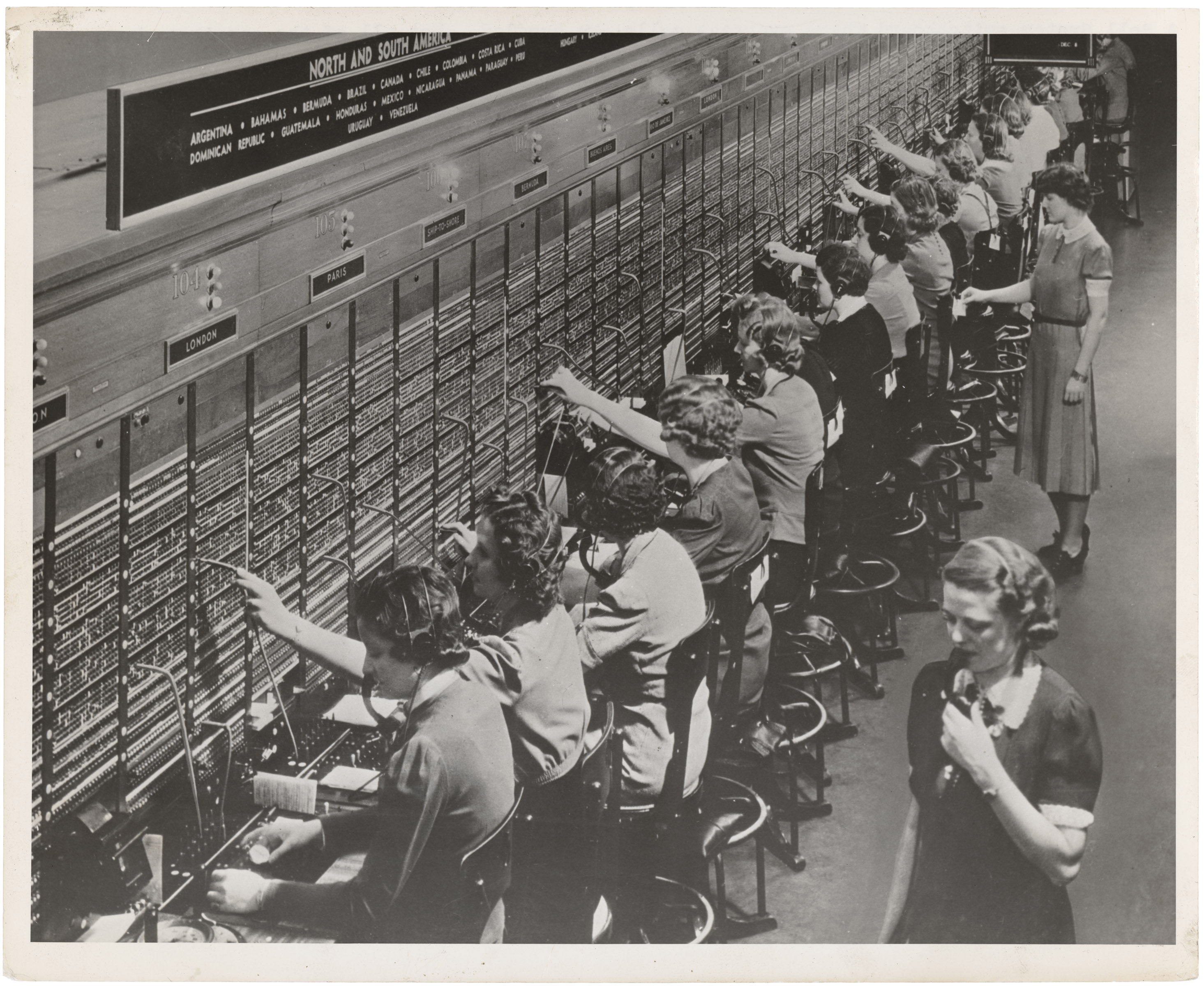
U.S. National Archives
If you’re of a certain age, you remember these women.
Some of you were these women.
Then, city by city, the phone company threw the switch to automated dialing.
The engineers had a word for that moment — the day the machines took over a system that people used to run.
They called it a cutover.
Remember the word, because you’re living inside the biggest one ever attempted.
When a city was cut over, the operators’ work didn’t wind down.
It ended — one morning, all at once.
And the economists who later studied those cutover cities found that the displaced operators were less likely to be working at all a decade on… and when they did work, they earned less.
They called it a cutover.
Remember the word. You’re living inside the biggest one ever attempted.
And here’s the eerie footnote that proves the pattern: the occupation never officially died.
As recently as 2023, the Bureau of Labor Statistics still counted roughly 43,800 Americans under “switchboard operators, including answering service.” The title survived. The 350,000-strong profession — the one-in-13 employer of American women — did not.
The name on the table is a gravestone that the statistics mistake for a person.
So the next time an expert reassures you that AI “won’t eliminate jobs — it will just change them,” understand what that sentence has always meant on a pay stub.
The law doesn’t need your job title to die.
It only needs the work to move.
The wages follow the tasks, not the title — and they leave years before the occupation gets its obituary, if it ever gets one at all.
But every dollar that left those switchboards landed somewhere — and where it landed is the part of the story nobody ever taught you.
It landed in AT&T.
For most of the twentieth century, AT&T was the largest company in the world. $75 billion in assets. More than a million employees.
Because Washington regulated it as a monopoly, the money the operators used to earn couldn’t show up as a soaring stock price.
So it showed up as sheer size — and as a dividend check, mailed out quarter after quarter to more than three million ordinary American shareholders, without interruption, since the 1880s.
Analysts had a name for it. Shoebox stock.
Certificates held so long they’d been stuffed in a shoebox somewhere and passed down with the wedding china.
Then in 1984, the government broke the company into pieces — and fifty years of stored-up value came out all at once.
$1,000 in 1983 exploded to more than $108,892 today. Or, every $10,000 into $1.09 million.
$1,000 → $108,892+ — or every $10,000 into $1,089,180
Basis: hypothetical $1,000 invested in AT&T common stock at the Dec. 30, 1983 divestiture record date, held continuously in the AT&T entity that trades today as AT&T Inc. (NYSE: T) — the Southwestern Bell line, which later reacquired Pacific Telesis, Ameritech, BellSouth and AT&T Corp. itself — with all dividends reinvested. Behind the Markets calculation.
Source: Behind the Markets analysis of AT&T Inc. (NYSE: T) daily total-return data via Yahoo Finance, Nov. 1983 – Aug. 2026, and AT&T Corp. divestiture distribution terms. Past performance does not guarantee future results.
The operator lost her job in the cutover. The family with the certificates in the shoebox made generation wealth.
Now — before I show you what I believe is the single biggest example of Slater’s Law at work today…
I need to close off the escape hatch your mind is probably reaching for right now.
The one that says: surely the machines can’t actually do the work.
The Résumé of the New Workforce
Every prior generation of “thinking machines” was oversold. So let me give you three entries from the new workforce’s résumé — each one a matter of public record.
Entry one. Medicine. Every drug ever made starts with the shape of a protein.
Working out those shapes was one of the great projects of modern biology — fifty years of the world’s best-paid scientists produced about 190,000 of them.
Then an AI called AlphaFold worked out 200 million. Nearly all of them. In months. And gave the whole library away, free.
Fifty years of salaried genius, beaten a thousand times over by something that never drew a salary.
Fifty years of salaried genius, beaten a thousand times over by something that never drew a salary.
Source: Google DeepMind; MIT Technology Review, July 2022
And in the operating room, the machines have already been paid.
A company called Intuitive Surgical sells the robot that surgeons now operate through — more than 11,000 systems installed, over 20 million procedures performed. The surgeon still does the surgery.
But he does it through a machine somebody else owns, and that owner collects on every single operation. That stock went public in 2000 at $9 a share. It has returned more than 30,000% since.
$1,000 became $305,225.
$1,000 became $305,225.
Source: Yahoo Finance, daily closes, June 2000 – August 2026, adjusted for the 1-for-2 (2003) and two 3-for-1 (2017, 2021) splits.
Entry two. Engineering. Consider what it takes to make a chip designer. Four years for the degree. Then a master’s or a doctorate.
Then 18 to 36 months of training on the job before he can be trusted with production silicon. A decade. To make one person who can design one piece of one chip. And America can’t make them fast enough.
The Semiconductor Industry Association projects 67,000 of these jobs will simply go unfilled. Deloitte says the world needs a million more of these workers by 2030.
As one industry report put it: money can build factories, but it cannot produce experienced engineers overnight.
A decade. To make one person who can design one piece of one chip.
Source: Semiconductor Industry Association workforce projections; Deloitte semiconductor talent analysis (1 million additional workers needed by 2030).
Now — the job that decides whether a chip works is called verification. Checking a design for the errors that would ruin a billion-dollar production run.
For a trained engineer, it takes about five weeks.
This past May, at a conference in Taiwan, a company called Cadence announced it had cut those five weeks to less than a day.
40-times faster.
It calls the thing that does it a virtual engineer.
And it wasn’t a demonstration — Nvidia’s own engineers were already running millions of tests with it, in live production, before the announcement was made.
Wall Street didn’t wait for proof. The stock jumped 8.7% before the market opened.
And the spring told the real story: shares went from $297 in mid-April to above $405 seven weeks later, as the market worked out what a virtual engineer actually means.
Announcement: Cadence press release, May 31, 2026 (Computex). Price data: split-adjusted closes plotted from period anchors. The navy dashed line grows the same 2011 share price at 12% a year for comparison; the seven-week spring move is shown at full scale in the inset.
Then in July the receipts arrived — revenue up 24%, margins of 45.5%, a record $8.1 billion in orders, and management raising its forecast by the largest amount in company history.
And already being weaponized by Nvidia, the largest company on Earth. But here is the part I want you to hold onto, because it’s the reason I’m telling you this story at all.
Cadence has done this before. There was a time when computer chips were drawn by hand. Actual draftsmen, cutting patterns into sheets by hand, laying out circuits the way an architect lays out a building.
It was a skilled trade. It supported thousands of families. Cadence’s software erased it. And the wages that used to be paid to those draftsmen didn’t vanish.
They moved — into a software company in San Jose. Over the last fifteen years, that company’s stock has returned 3,626%.
It has compounded at nearly 30% a year while the rest of the market managed 12%. And it could be preparing to do the same thing, all over again.
The same company that automated away the men who drew chips by hand… is automating away the engineers who replaced them. Same law. Same company. Second helping.
Five weeks of a trained man’s work, done in a day, by something that will never be trained, never be paid, and never go home.

U.S. federal photograph (TSgt Bob Wickley), NARA
Entry three. Everywhere else — and this is the one that tells you the office is next.
Early this year an open-source project called OpenClaw — software that lets anyone build autonomous AI agents to carry out real tasks — became the fastest-spreading project in the history of GitHub, the world’s code repository.
Within weeks, users had created some 1.5 million agents.
In March, the chief executive of the most valuable chipmaker on Earth stood on a stage and called it the operating system for personal AI, and said every company in the world now needs a strategy for it.
Reading. Writing. Filing. Checking. Scheduling. Corresponding.
The daily motions of the American office job — being performed right now by workers who don’t eat, don’t sleep, and don’t cash a paycheck.
And this is where the clock changes.
The first two took decades to pay off.
This one is paying now.
One company selling software that does the work of human analysts — inside government agencies, hospitals, banks, factories, and defense departments — has risen more than 3,000% since early 2023.
Under three years. Thirty times your money. Not in a laboratory or a chip plant, but across every industry at once.
One company selling software that does the work of human analysts
3,000%+Under three years. Thirty times your money.
Not in a laboratory — inside government agencies, hospitals, banks, factories, and defense departments.
And you don’t have to take the new workforce’s résumé from me.
Take it from the men writing it.
In January of last year, Sam Altman — the CEO of OpenAI — published a prediction on his personal blog: “We believe that, in 2025, we may see the first AI agents ‘join the workforce’ and materially change the output of companies.”
Join the workforce. His quotation marks, not mine.
Eighteen months later, on stage at a technology conference, he described what he was now watching inside companies:
“You hear people that talk about their job now is to assign work to a bunch of [AI] agents, look at the quality, figure out how it fits together, give feedback… It sounds a lot like how they work with a team of still relatively junior employees.”
“We believe that, in 2025, we may see the first AI agents ‘join the workforce’ and materially change the output of companies.”
Sam Altman, CEO of OpenAI — personal blog, January 2025
“You hear people that talk about their job now is to assign work to a bunch of [AI] agents, look at the quality, figure out how it fits together, give feedback… It sounds a lot like how they work with a team of still relatively junior employees.”
on stage, eighteen months later
Source: Sam Altman, “Reflections,” blog.samaltman.com, January 2025
And Jensen Huang — the CEO of the most valuable chipmaker on Earth — put it flatly at a financial conference: “future workforces in enterprise will be a combination of humans and digital humans.”
“future workforces in enterprise will be a combination of humans and digital humans”
— Jensen Huang, at a financial conference
A workforce. Junior employees. Digital humans.
A workforce. Junior employees. Digital humans.
The men building the machines have stopped talking about tools.
So the machines can do the work — and their makers say so in public, on the record, in the language of employment.
Which forces the only question left, and it’s the frightening one: how fast?
I’m going to answer that…
And soon, I’m going to give you the details on the one company to own right now.
The company at the perfect intersection of all these industries… $13 trillion… and Slater’s Law.
The 75-Year Job Loss That Now Runs on a 36-Month Clock
All the times we’ve seen Slater’s Law change industries or business, we’ve seen it work slowly for one reason: the machinery had to be built.
Spindles had to be forged and freighted.
Assembly lines had to be poured in concrete.
Copiers weighed 648 pounds and shipped one truck at a time.
Even the personal computer had to be manufactured, boxed, and delivered to one desk after another, year after year.
The transfer moved at the speed of freight.
This time, it’s software moving into hardware that is already installed, already paid for, already sitting on every desk in America.
You can watch the compression in data we already have.
The travel agents were among the first office professions the internet came for — and in about ten years, nearly half the profession was gone.
I’ll show you their full story in a moment, because what happened to their wages is one of the most spectacular payouts in this letter.
That was the old speed — the speed of a technology that still needed websites built and habits changed, desk by desk.
The men closest to the new technology don’t expect anything like ten years.
In May of last year, Dario Amodei — CEO of Anthropic, one of the world’s leading AI labs — went to the press with a warning that stunned even Silicon Valley: that AI could eliminate half of all entry-level white-collar jobs and push unemployment to 10 or 20 percent… within one to five years.
His words on why he said it out loud: “We, as the producers of this technology, have a duty and an obligation to be honest about what is coming.”
Then he added the eight most chilling words a builder can say about his own creation: “I don’t think this is on people’s radar.”
AI could eliminate HALF of all entry-level white-collar jobs
10–20% unemployment — within 1 to 5 years
“We, as the producers of this technology, have a duty and an obligation to be honest about what is coming.”
“I don’t think this is on people’s radar.”
Dario Amodei, CEO of Anthropic — May of last year, to the press
Source: Axios interview, May 28, 2025
It’s on yours now.
The technology that arrived in the last 36 months writes, reads, files, checks, schedules, negotiates, and reports — the core motions of tens of millions of office jobs — and it deploys not by truck, but by download.
By one estimate circulating through the enterprise-software world, 40% of large-company applications will carry autonomous AI agents by the end of this year, up from under 5% last year.
Automation Week wasn’t an anomaly. It was a starting gun.
<5% → 40%Share of large-company applications carrying autonomous AI agents — in a single year.
It deploys not by truck, but by download.
Automation Week wasn’t an anomaly. It was a starting gun.
And Wall Street has already begun paying the owners’ side.
You already know the analyst-software company that’s up more than 3,000%. It got there by at least doubling three years in a row.
Three straight years. Almost no company in market history has done that.
Which raises the only question that matters:
If the transfer has started… where, exactly, is the money moving from? And who, exactly, is set up to collect it?
Look at Your Pay Stub
The “from” is not a mystery. It’s printed on a document most Americans receive every two weeks.
This year, American employers will pay out roughly $13 trillion in wages and salaries.
Not profits — paychecks.
It is the largest pool of money on the planet.
It dwarfs every corporate profit in America combined.
It’s nearly twice the entire federal budget.
It is the largest pool of money on the planet.
Not profits — paychecks. Nearly twice the entire federal budget.
Your paycheck — or the pension and Social Security built from your decades of paychecks — is a line item in that pool.
And if a $13 trillion transfer sounds like an exaggeration, understand that the men selling the synthetic workers size it the same way.
Here is Marc Benioff — the billionaire founder of Salesforce, whose stated mission is now to become “the No. 1 digital labor provider, period” — sitting across from Ray Dalio, the founder of the world’s largest hedge fund:
“It is the shift to digital labor. It is the 3 to 12 trillion dollar global shift where we are going to see digital labor takeover.”
— Marc Benioff, founder of Salesforce, sitting across from Ray Dalio
His stated mission: “the No. 1 digital labor provider, period.”
$3 to $12 trillion. From the man selling the labor.
And for 236 years, Slater’s Law has obeyed one rule without exception: when the pool shrinks, it doesn’t shrink evenly.
It shrinks one desk at a time… and every dollar that leaves a desk reappears on the ledger of everyone investing in the machine.
A 60-year-old reader with $400,000 saved is holding the compressed residue of roughly forty years of paychecks — four decades of standing in the pool.
The transfer now underway doesn’t only decide what tomorrow’s workers earn.
It decides what the businesses, pensions, and portfolios built on top of yesterday’s paychecks are worth — which side of every one of those dollars ends up compounding, and which side ends up shrinking.
You cannot vote this away. You cannot bargain with it. The spinners of 1790 tried. The operators of 1950 tried. The bookkeepers tried.
There have only ever been two positions: in the pool that’s vanishing, or on the profit side absorbing it.
And as you’re about to see, the profit side hasn’t merely been protected from the transfer.
It has been paid by it — historically, gains of ten… a hundred… even a thousand times ordinary investors’ money.
Watch What the Machine-Builders Do With Their Own Money
If you want independent confirmation that the smart money reads this the way I do, don’t listen to anyone on television. Watch what the people closest to the technology do with their own money.
In November, SoftBank — one of the largest technology investors on Earth, and one of the earliest backers of the AI hardware boom — sold every Nvidia share it owned. All 32 million of them.
$5.83 billion, gone in a single month. Then it sold $9.17 billion of T-Mobile. Then it borrowed against its stake in the chip designer Arm.
Its chief financial officer explained exactly why, on the record: the investment they were funding was so large that they had to sell what they already owned to pay for it. What were they buying?
$22.5 billion of OpenAI in a single quarter — more capital in three months than SoftBank had deployed in the previous two years combined — on the way to nearly $35 billion.
It lifted their ownership of the company from 4% to 11%. Look at what that trade actually is. Out of the company that makes the machines. Into the company that makes the workers.
Watch What the Machine-Builders Do With Their Own Money
Out of the company that makes the machines. Into the company that makes the workers.
Nvidia sale: CNBC, Nov. 11, 2025.
And Nvidia’s own people have been doing a smaller version of the same thing.
Over the past year, the Financial Times tallied more than a billion dollars of Nvidia stock sold by company insiders, while the CEO completed a pre-planned sale of over a billion dollars of his personal shares.
And then, if you have any doubts about why he did that… Nvidia then invested $30 billion in OpenAI and up to $10 billion in Anthropic.
Then in March he stood on a stage in San Francisco and said those investments would probably be his last ones. His reason? Both companies are about to go public. He wasn’t saying the opportunity is over.
He wasn’t saying the opportunity is over. He was saying the cheap part is over — that the window for getting in before the crowd is beginning to close.
And I’m telling you the same thing.
Across the whole AI-hardware complex, insider buying has nearly vanished.
Let me be fair: every one of those sales was legal, scheduled in advance, and fully disclosed.
Executives sell for a hundred reasons. That isn’t the point.
The point is the direction.
At the very top of the tool-building trade, the money flows one way — out of the tools, and into whatever comes after them.
In a moment, I’m going to give you the solution…
Not Anthropic. Not OpenAI. Not Salesforce.
A company you likely have never heard of… and yet it will be central to the tectonic $13 trillion shift driven by Slater’s Law… with the potential to turn even a $1,000 stake into more than $100,000 in the years to come.
But first…
The Payout Side of the Ledger
You have to see what’s really possible for investors on the profit side of the ledger.
I’ve given you a snapshot with some of the examples of Slater’s Law at work… but to see the true, incredible power of how this law has continued to shape American industry for 236 years…
And why you MUST be on the right side of it, urgently…
You need to see the raw numbers of what’s possible.
Because I’ll be honest – the types of windfalls this law makes possible are almost without equal in the market.
Start with the profession the internet hit first.
The travel agents.
In 2000, at the profession’s peak, 124,000 Americans earned their living booking trips. Then the booking websites arrived and did an agent’s work without the agent.
By 2012, about 65,000 remained.
And notice the law’s signature on the survivors: the agents still working fled upmarket, into luxury and specialty travel for clients who pay a premium for a human voice.
The title lived.
The storefronts, the middle of the profession, the ordinary wage — those left.
Where did the wages go?
Into Booking Holdings.
The company came out of the dot-com wreckage so battered it had to reverse-split its stock in 2003 just to keep the share price respectable — roughly $20 a share.
From there, as the agents’ industry emptied, it climbed.
And climbed. Until at its peak last summer, each of those 2003 shares was worth $5,767, split-adjusted.
A gain of as much as 28,700%. Enough to turn $10,000 into roughly $2.87 million.
$10,000 into roughly $2.87 million — about $20 a share in 2003, peak $5,767
Bought in 2009 — a decade after the internet revolution supposedly peaked? Still roughly 20× over the next seven years.
Source: Yahoo Finance, split-adjusted closing prices plotted from period anchor closes, June 2003 – August 2026; months between anchors are smoothed. Travel-agent counts: 124,000 (2000) → ~65,000 (2012).
And you didn’t need to be early.
Investors who bought in 2009 — a decade after the internet revolution supposedly peaked — still watched the stock multiply roughly twenty times over the next seven years.
Then there’s the video store clerks. Nine thousand Blockbusters, a clerk behind every counter, on every commercial strip in America. It was a first job for a generation.
In 2002, a mail-order DVD company with 600,000 customers went public at $15 a share. Blockbuster’s executives had already turned down the chance to buy it.
By 2010 Blockbuster was bankrupt and every one of those clerks was gone.
The company was Netflix.
A $10,000 stake at that IPO grew to roughly $3.2 million — a gain of more than 32,000%.
$10,000 at the IPO into roughly $3.2 million
2010 — Blockbuster bankrupt; 9,000 stores gone.
Source: Yahoo Finance, split-adjusted closes. Plots the value of a $10,000 stake bought at the May 2002 IPO, May 2002 – August 2026.
And don’t forget – even the job of storing, loading, and mailing the DVDs vanished when Netflix switched to internet streaming. Or the typesetters. This was a real trade.
Men apprenticed for years to run a Linotype, and the union that protected them — the International Typographical Union — was one of the oldest in America, founded in 1852, more than 60,000 strong by the First World War.
These were not marginal jobs. In September of 1980, a union Linotype operator earned $11.40 an hour and a hand compositor $11.61 — while the average American factory worker took home $6.85. 70% more.
In the same year, in the same country. Then in 1985 a small California company shipped software that let an ordinary desktop computer do the entire craft.
Within a decade, “desktop publishing” had swallowed the trade whole. The men saw it coming and could not stop it.
When the New York Times converted, the union negotiated the best terms it could get: lifetime employment for the 1,785 compositors and pressmen then on the payroll. The local voted 1,009 to 41 to accept.
They weren’t voting to save the trade. They were voting to be the last men in it — a pension for the living, and nothing for anyone who came after.
One of them, a 49-year-old typesetter, said, “My Daddy always told me ‘get a trade’, so I did my apprenticeship and became a Typesetter! Now I’m unemployable!”
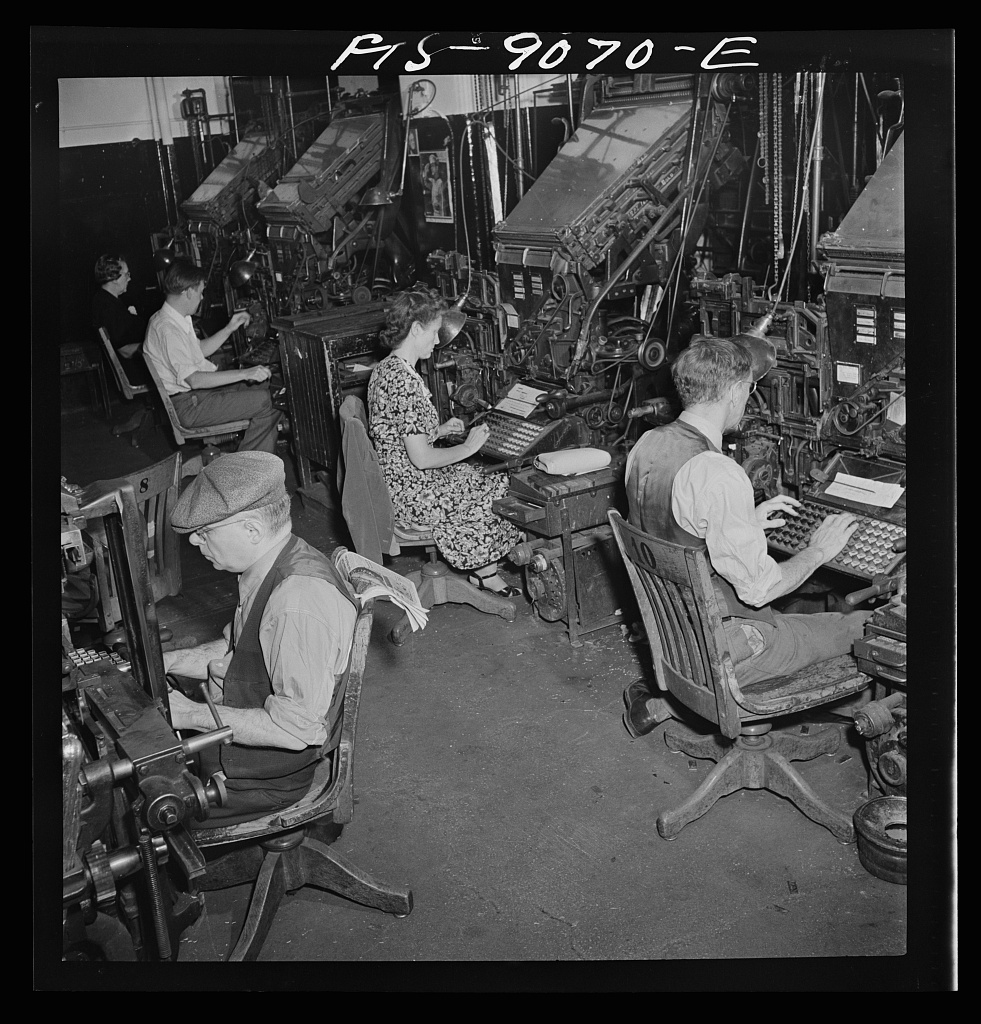
OWI, Library of Congress
“My Daddy always told me ‘get a trade’, so I did my apprenticeship and became a Typesetter! Now I’m unemployable!”
— a 49-year-old typesetter, after the New York Times conversion
The local voted 1,009 to 41 — a pension for the living, and nothing for anyone who came after.
He had done everything right. He’d followed advice that had been true in America for two hundred years. And a piece of software made it worthless inside a single career.
Now here is where those wages went. The company was Adobe. It went public in August 1986. At its November 2021 peak of $688.37, the run from that 1986 offering worked out to as much as 200,000%.
$10,000 would have turned into $20 million. And once again, the latecomers did fine.
From 2012 to 2021 alone — long after Adobe was a household name, long after everyone knew the story — the stock still multiplied roughly 24 times.
$10,000 into $20 million — and 2012–2021 alone was roughly 24×
Source: Yahoo Finance, split-adjusted closes. Plots the value of a $10,000 stake from the August 1986 offering to the November 2021 closing peak of $688.37.
The trade is gone. The union disbanded in 1989. And the money that used to be paid to those men every Friday is still being paid out today — just not to them. Starting to see it?
Three unrelated industries — and each time, knowing which way Slater’s Law would play out led to life-altering gains of 28,700%… 32,000%… 200,000%.
It’s why I believe right now, one company is on the verge of turning every $1,000 into $100,000.
But I have one more example you might recognize to see exactly how dramatic this situation really is…
The Typing Pool’s Revenge
Through the 1970s, every serious American office ran on a typing pool — rooms of typists, stenographers, and secretaries producing the paper that business ran on.
Word processing software ended that world.
The company that owned the replacement was Microsoft.
Since its 1986 debut, Microsoft has returned as much as 417,940%.
$10,000 into roughly $41 million.
$10,000 into roughly $41 million — doubled in year one, 100× inside ten years
The single greatest payout in the history of Slater’s Law — so far.
Basis: from the 1986 debut, split-adjusted, at the run’s peak. Source: Yahoo Finance, split-adjusted closes; plots the value of a $10,000 stake from the March 1986 debut to the 2026 closing peak.
And no, you didn’t need to wait decades for the reward: the stock doubled in its first year as a public company and multiplied more than 100 times within its first ten.
But here is the part of the Microsoft story that I want you to sit with, because it contains the entire message of this letter in miniature.
By 2000, according to the New York Times, Microsoft had created an estimated 10,000 millionaires.
And they were not all engineers.
The early employees who accepted shares as part of their pay included secretaries.
Receptionists. Marketing assistants. Office managers.
The Washington Post profiled one of them by name: Randall Thatcher — an office gofer whose job, in his own telling, was fetching dry cleaning for a boss he loathed.
He took his stock options. They made him a millionaire.
A few years later, it happened again down the road at Google, where the New York Times counted the company’s former masseuse, Bonnie Brown, among the options millionaires.
Think about what that means.
Inside the very company that was automating the typing pools of America, the typists and receptionists who held ownership walked away wealthy… while people doing identical work across the street — same skills, same desks, same hours — held nothing but a paycheck, and watched their profession dissolve.
Same job. Two utterly different fates.
The difference was never talent, or effort, or luck.
The difference was which side of the machinery they stood on.
Same job. Two utterly different fates.
The difference was never talent, or effort, or luck.
That is Slater’s Law, demonstrated inside a single building.
And it brings us to the fourth firing — the one aimed at you. The one playing out in the world, right now.
Why the Fourth Firing Is Different From the First Three
Every previous example shared one merciful limitation: it emptied one profession at a time.
The spinners. The operators. The typists. The agents. The bookkeepers. Each transfer was contained to a trade. Even the video store clerks.
The technology behind Automation Week has no such limit.
It performs the general motions of office work itself — reading, writing, checking, filing, scheduling, analyzing.
It is aimed at the pool, not at a profession.
And there is a second difference — the one that determines where the money lands.
In every previous example, the winning investment was the company that sold the machine.
Xerox sold copiers. Microsoft sold software. Adobe sold programs.
The customer still had to supply the worker to run them.
This time, for the first time in 236 years, a company has begun selling the worker.
Not a tool that helps your employees.
A synthetic employee.
Trained, supervised, auditable — and delivered through a platform its customers are already locked into.
One company crossed that line first.
This past May, in an official press release, its founder described the company’s newest offering in a way no major American CEO had ever described a product before — two words:
“Agentic labor.”
Not software. Not productivity. Labor.
The CEO of a company most Americans have never heard of announced — in plain English, on the public record — that his company’s newest product line is workers.
“Agentic labor.”
Not software. Not productivity. Labor.
— the founder and CEO of a company most Americans have never heard of, in an official press release
When I read them, I stopped what I was doing and pulled every filing, release schedule, and customer disclosure the company has issued. What I found is the cleanest setup the law has ever produced. I’ll walk you through it in a moment, piece by piece.
Exactly why I believe one company is positioned right here, right now, to unleash the kind of gain that could turn even a $1,000 stake into more than $100,000.
Here is what I found.
The Synthetic Employer
I’ve taken to calling this company the Synthetic Employer, because that is literally the business it has entered.
Think of the great staffing agencies of the last century — Manpower, Kelly — firms that recruited, trained, supervised, and billed out millions of workers.
Now imagine that business where every worker on the roster is synthetic: never hired away, never off sick, never off the clock. Recruited once.
Billed forever.
Think of the great staffing agencies of the last century
Recruited once. Billed forever.
And notice where it chose to prove the model.
Not customer service. Not marketing copy. Not code.
It sent its first synthetic hires into the hardest white-collar arena in America — the drug industry’s compliance floor, where a single wrong claim draws federal warning letters and a stalled filing burns a fortune by the day.
That was the point. If a synthetic worker can hold down a job there — audited, validated, inspected — it can hold down a job anywhere on Earth. Watch the first shift.
THE FIRST SHIFT.
It already happened.
On December 3rd of last year, somewhere inside one of the world’s largest drugmakers, a piece of promotional material that once waited days for a human compliance team’s red pen was scanned against brand, market, and regulatory guidelines and flagged for problems… before a single human reviewer opened the file.
The worker that did it has a name in the company’s own catalog: the Quick Check Agent.
It clocked in that day alongside digital colleagues that draft field notes, transcribe conversations, and prep sales calls.
No salary. No benefits. No sick days.
And every keystroke logged inside the validated audit trail — exactly the way the regulators demand.
The first synthetic hires didn’t arrive with a press conference.
They arrived with a software update. They have been working ever since.
Flagged for problems before a single human reviewer opened the file.
Its name in the company’s own catalog: the Quick Check Agent
No press conference. A software update.
Here’s the big thing to understand – this isn’t a “minor labor” or “work optimization.”
That review is six-figure work — the average American regulatory affairs professional earns about $123,000 a year, roughly double the median U.S. wage.
It’s work so specialized that drug companies pay outside firms billions of dollars a year just to rent it.
There’s somewhere north of 137,000 people in this line of work.
That review is six-figure work
$123,000the average American regulatory-affairs professional, per yearThe agent ran the first pass in seconds, on its first day.
The agent ran the first pass in seconds, on its first day, with every keystroke logged.
And notice: nobody was fired that afternoon.
That is not how Slater’s Law works — you know that by now. The title stays. The work moves. It moves exactly like this — one pass at a time, inside the audit trail, while the org chart still looks the same.
So the proof of concept is already running — staged, deliberately, on the hardest ground in the American economy.
What turns a proof of concept into a monopoly?
Three tells, straight from the public record — each one bigger than the last.
Tell #1: The Confession
On May 27, the company’s founder and CEO announced its new platform as — his words — the company’s “first offering in agentic labor.”
Understand how chief executives normally talk about this technology.
They hide behind the soft words — copilot… assistant… productivity tool. Words chosen by lawyers so nobody has to say out loud what the thing actually does.
This man said labor.
And weigh the man saying it.
He founded this company back in 2007, after helping build two of the software industry’s giants — and he has run it for nearly two decades with an outright allergy to hype.
No breathless keynotes. No moonshot promises. No chatbot demos.
In 25 years of reading corporate filings, I have never seen a chief executive of that temperament declare that his product is labor.
When a man like that writes those words into a press release, it isn’t marketing.
It’s a construction permit.
“It isn’t marketing. It’s a construction permit.”
And it wasn’t vague.
The same announcement listed the first jobs on the synthetic roster: processing clinical trial master files… answering correspondence from health authorities… triaging drug-safety cases. The daily work of the six-figure specialists you just met on the first shift.
First offering. Meaning a product line.
Meaning a roadmap — with wave after wave of synthetic hires already scheduled behind it.
Marc Benioff of Salesforce calls this new industry “digital labor,” sizes it in the trillions, and wants to sell it to the whole world.
This company had a quieter, colder idea: sell it to the one industry that cannot say no — and cannot leave.
But a confession is only words — and words are the weakest of the three tells. The second is structural. It’s the reason no competitor on Earth can follow him through the door.
Tell #2: The Only Door
The industry is the drug business: the companies that carry medicines through years of trials, filings, and government review.
No industry on Earth is watched more closely.
Every document. Every data point. Every signature. All of it under federal rules, audit trails, and inspection.
And the watching has a name.
In August of 1997, the federal government enacted a rule called Title 21, Code of Federal Regulations, Part 11 — the law governing every electronic record and every electronic signature in this industry.
It requires that any system touching regulated work be formally validated before use… every change captured in a secure audit trail… every user access-controlled… every signature verified and legally binding. It was written to keep sloppy software away from drug approvals, back when factories still ran on clipboards and paper batch records.
29 years later, that 1997 rule has quietly become something its authors never imagined: a federal licensing law for synthetic workers.
1997 → 2026: a federal licensing law for synthetic workers.
Source: 21 CFR Part 11 (1997)
And the FDA enforces it with a hammer.
The agency’s operating premise is brutally simple: if it can’t trust your records, it can’t trust your product. Data-integrity failures are the single most-cited violation in FDA warning letters — showing up in as many as 60 to 80 percent of them.
In the second half of last year alone, the agency fired off 327 warning letters. Up 73 percent from the year before.
And warning letters are the gentle stage.
Ignore them and the ladder climbs: import bans… product seizures… consent decrees that have cost companies fortunes — $500 million at Schering-Plough, more than $1 billion in total remediation at Abbott.
Plus a clause most investors have never heard of: the FDA deems profits earned while a company is out of compliance to be illegal — and subject to seizure.
And the FDA enforces it with a hammer.
This is not an industry that experiments with unproven help.
In this industry, unproven help can cost a company its revenue.
Literally.
Which creates a hiring rule with no exceptions: this industry cannot use a worker it cannot prove.
A synthetic worker off the open internet is unhireable here — no matter how smart it is. No audit trail. No access controls. No approved home to run in. Regulators would torch any filing it touched.
There is exactly one door a synthetic worker can walk through to get hired in this industry: the secure, validated platform where the industry’s regulated work already lives.
One company owns that platform. Its systems have become the industry’s filing cabinet, workbench, and compliance record all at once.
By its own investor disclosures, more than 100 of the industry’s companies are live on its newest platform generation — including seven of the world’s 20 largest drugmakers, two of them already running it in major markets.
Its synthetic workers aren’t fighting for a job. They’re the only applicants allowed in the building.
Its synthetic workers aren’t fighting for a job. They’re the only applicants allowed in the building.
And if you doubt how strong that door is, watch what the AI giants do when they reach it.
They don’t kick it down.
They hand over their models.
The frontier AI built by the biggest names in the business — the same names dominating the headlines — runs inside this company’s walls.
Under its permissions. Its audit trails. Its rules.
Because Part 11 leaves them no other way in: the mightiest AI labs on Earth can only reach this industry by clocking in under this company’s validated roof.
When the giants’ models improve, this company’s workers improve — at no invention cost to itself.
It has turned the entire AI arms race into its own free hiring pipeline.
They don’t kick it down. They hand over their models.
The secure, validated platform — under its permissions, its audit trails, its rules.
When the giants’ models improve, this company’s workers improve — at no invention cost to itself.
Position. Moat. A free arms race. All that’s missing is a date.
There are two — and the first has already fired.
Tell #3: The Switch
On August 7, the company’s scheduled software release switched on its AI layer for every customer on the platform at once — led by its first synthetic workers for clinical and regulatory operations, some of the most expensive white-collar labor in the entire industry.
In the engineers’ language, it was a cutover — the largest one ever scheduled.
An entire industry’s regulated work, switched to synthetic hands, in a single software release.
And in this cutover, every new hire bills through one company.
You already know what made every previous firing slow: the spindles, copiers, and computers shipped by truck, one customer at a time.
This one ships as a download — to an entire installed industry, overnight.
There is no 75-year adoption curve here.
There isn’t even a ten-year one.
The switch simply flips. On the 7th, it did.
And the company’s own disclosures already map the waves behind it: new classes of synthetic workers rolling out across safety, quality, medical, and commercial operations throughout this year… with the industry’s crown-jewel work — clinical data itself — targeted for 2027.
Wave after scheduled wave.
And the second wave already has a date.
This November, the company’s synthetic workers report for their first paid shifts inside its earliest customers — the labor platform’s first true payroll.
The switch-on opens the door. November starts the billing.
Each one a new class of billable digital employees. Each one available only inside the walls.
When the billing starts in November, the market gets its first clean look at synthetic labor as a billable revenue line.
Tell #3: The Switch
Dates are the company’s release windows, per its own disclosures. The August release went live August 7, on schedule.
I believe that look changes what this company is worth — and the investors already positioned will have first chance at whatever follows.
Why Wall Street Is Still Asleep on This
At this point you may be wondering: if the evidence is sitting in public filings, why hasn’t the market already priced it in?
Why does the loudest AI money keep chasing chipmakers and chatbot stocks instead?
Three reasons — and each one works in your favor.
First, the company wears camouflage.
Its customers are drug companies.
Its conferences are about clinical documentation and regulatory workflow.
There is no gaming division, no robot demo, no viral chatbot.
To a Wall Street screen, it files under “steady enterprise software” — a category the AI crowd finds boring.
The same way Nvidia was miscategorized as a company for graphics cards for gaming PCs.
And now it’s the largest company on Earth.
This company is being valued by who its customers are right now… not by what its product is about to make possible.
The same as Nvidia before it ran from $5… to $200.
The same way Nvidia was miscategorized
Filed under gaming graphics. Now the largest company on Earth.
This company is being valued by who its customers are right now… not by what its product is about to make possible.
Second, the labor isn’t on the books yet. Wall Street doesn’t price stories in boring industries. It prices line items.
And the synthetic-labor line item doesn’t exist yet — the first digital workers only clocked in this past December, and the all-customer switch didn’t flip until August 7.
There is no quarterly report, anywhere, showing what a synthetic workforce bills.
So every analyst model on the Street is a photograph of yesterday’s company: a steady software vendor with steady software revenue.
The labor business is sitting in plain sight — announced, scheduled, dated — and in their spreadsheets it appears as a zero.
You just watched this exact blindness on the chip-design side, in writing.
When Goldman Sachs finally sized what synthetic engineers would be worth to the design-software companies, its own analyst admitted the number was “not reflected in Street estimates.” The Street doesn’t price what’s been announced.
It prices what’s been filed. Which means the repricing can’t begin until the labor line shows up in a filing — and the first billable shifts don’t start until November. You’re reading this letter on the correct side of that date.
Third — and this is the part I find almost unfair: the boring industry is a moat. Let me show you what happens to AI companies that don’t have a moat like this.
The raw product of this revolution — machine intelligence itself — is collapsing in price faster than any product in commercial history.
In March of 2023, running a million tokens through GPT-4 cost $30. Today, the same grade of intelligence costs under 50 cents. A 98% collapse in about three years.
One of Silicon Valley’s biggest venture firms coined a word for the phenomenon — “LLMflation” — and Marc Andreessen calls it “extreme deflation of the cost of intelligence.”
$30 per million tokens → under 50 cents. “LLMflation.”
“extreme deflation of the cost of intelligence” — Marc Andreessen
Vertical axis is logarithmic so a 95% collapse stays readable. Gold line: published price per million tokens of comparable raw model output, March 2023 – August 2026. Dashed line: validated, licensed output, whose price does not fall — illustrative, not a quoted series.
Now think of that as an investor.
Every AI company fighting in the open field is selling a product whose price is racing toward zero — undercut every ninety days by some new rival, in a price war with no floor.
That is what “hot AI startup” actually means on an income statement. Then look over the wall.
You’ve already seen what a walled arena pays — the company the entire chip industry must design through compounded at nearly 30% a year for a decade while the broad market managed 12.
And its wall is merely complexity. The Synthetic Employer’s wall is a federal statute. And it works in both directions: it keeps competitors out, and it keeps customers in.
Here is the sentence I’d frame if I ran this company: while the price of raw intelligence falls toward nothing, the price of validated intelligence — intelligence trained and licensed to touch a drug filing or other federal document — doesn’t fall at all.
It goes up. Wall Street still reads “boring, regulated industry.” I see one of the most well positioned strategic assets in the stock market I’ve ever come across.
And I’m fully convinced this one company… virtually unknown to the general public… Could soon be the AI workforce supplier for countless industries… Ultimately making it possible to turn even a $1,000 stake into upwards of $100,000.
Heck, you’ve seen examples of a single situation where one stock roared 200,000%. Enough to turn $1,000 into $2 million. I think we are in the early innings of a global shift that could do exactly that.
What’s possible on the collecting side
“I think we are in the early innings of a global shift that could do exactly that.”
Solid gold = completed history (Adobe, split-adjusted closes, August 1986 – November 2021 peak). Dashed green = a forward-looking illustration based on that historical comparable, with no dates and no guarantee. Projections are not results.
But before we go further, here are a few of the most common questions I get when this comes up.
Three Questions I Know You’re Asking
“Isn’t this just another AI fad?”
Fads are demand-side stories — they need you to believe consumers will want something new.
This is a cost-side story: it needs only for businesses to keep doing what Automation Week proved they’re already doing at scale — replacing their most expensive line item with a cheaper one.
In 236 years, no employer has ever declined that trade for long.
The fad question answers itself every time a CEO announces a workforce reduction and watches his stock rise the same afternoon.
“Haven’t I already missed it?”
You could have asked that about every situation we’ve discussed today — and been wrong every time.
Investors who ignored the travel-agent story until 2009, a full decade into the internet era, still watched their stake multiply roughly 20 times.
Investors who came to Adobe in 2012, a quarter-century after its debut, still made roughly 24 times their money.
“Haven’t I already missed it?”
You could have asked that about every situation we’ve discussed today — and been wrong every time.
Windows as stated: 2009–2016 class (Booking); 2012–2021 (Adobe).
The window in Slater’s Law isn’t the invention of the machine.
It’s the interval between the machine working and the world understanding what that means.
You are inside that interval right now — the confession is dated May 27, the switch flipped on August 7, and the billing hasn’t hit a single filing yet.
The chance isn’t behind you. It’s in front of you.
You are inside that interval right now
The window in Slater’s Law isn’t the invention of the machine. It’s the interval between the machine working and the world understanding what that means.
“I don’t know the first thing about drug stocks.”
You don’t need to.
This is not a bet on any drug, any trial, or any FDA decision.
The Synthetic Employer gets paid whether its customers’ medicines succeed or fail. The scientists it’s replacing were paid the same way, after all. For the work, not the outcome.
You’re not buying the industry. You’re buying its paymaster.
What This Company Becomes
One more thing separates this situation from every AI stock being shouted about on television.
The famous AI names are priced for miracles.
The analyst-software company I mentioned earlier — the one up 3,000% in under three years — trades at a valuation that assumes near-perfection, and the market pays it because the story is loud.
The Synthetic Employer is quiet.
Its customers are boring.
Its industry moves in decade-long contracts and regulatory calendars.
And so, even now it trades at a fraction of the multiples the market hands to AI stories with none of its lock-in, none of its captive customers, and none of its labor roadmap.
The famous AI names are priced for miracles.
Wall Street is still pricing this company as what it was: a steady, essential software vendor.
Wall Street is still pricing this company as what it was: a steady, essential software vendor.
It has filed the paperwork to become something else entirely: the paymaster of the synthetic workforce — the firm that hires out, supervises, and collects on the digital employees of an entire industry… an industry that, by regulation, can hire them from nowhere else.
You’ve already seen what’s possible – companies turning $10,000 into $2.87 million… $3.2 million… $20 million… $41 million.
Every company on that ladder owned the machine that replaced one trade.
The Synthetic Employer is the first company in the law’s 236-year history positioned to own the replacement labor itself — for an entire industry, with the customers locked in by federal rule.
Everything You Need Is in This Report
I’ve put the complete case — including the company’s name, ticker symbol, my full analysis, and my recommended buy-up-to price — into a new briefing called:
“The New American Workforce: The One Stock to Ride During the Biggest Wealth Transfer of our Lifetime.”
Inside, you’ll find everything I couldn’t responsibly print in a public letter:
The company’s name and ticker symbol, with my recommended buy-up-to price — the level above which I’d wait for a better entry rather than chase.
The complete evidence trail, document by document, so you can verify every tell in this letter yourself in a single evening.
The milestone calendar: every scheduled switch-on and labor-platform date through next year, so you’ll know what’s supposed to happen, when — and what it means for the shares each time it does.
And the tripwires: the specific, observable signs that would tell me the thesis is weakening, so you’ll never be left guessing whether to hold. My readers don’t just get recommendations. They get the exits mapped in advance.
I’d like to send it to you today. Free.
Here’s how — and why.
An Invitation to Biotech Insider
The report is yours the moment you take a risk-free trial of my VIP biotech research service, Biotech Insider.
As a member, here’s what you’ll receive over the next 12 months:

Your bonus briefings, free with membership:
Synthetic workers don’t drive to an office.
But their work still travels — across the internet, every second of every day. And one company guards the gate it all has to pass through.
I gave my readers this name in May, while the market still files it under plain internet plumbing.
The agent traffic it polices is multiplying by the week — and in my judgment, the market hasn’t begun to price what that gate becomes. You get the full story and my buy-up-to price.
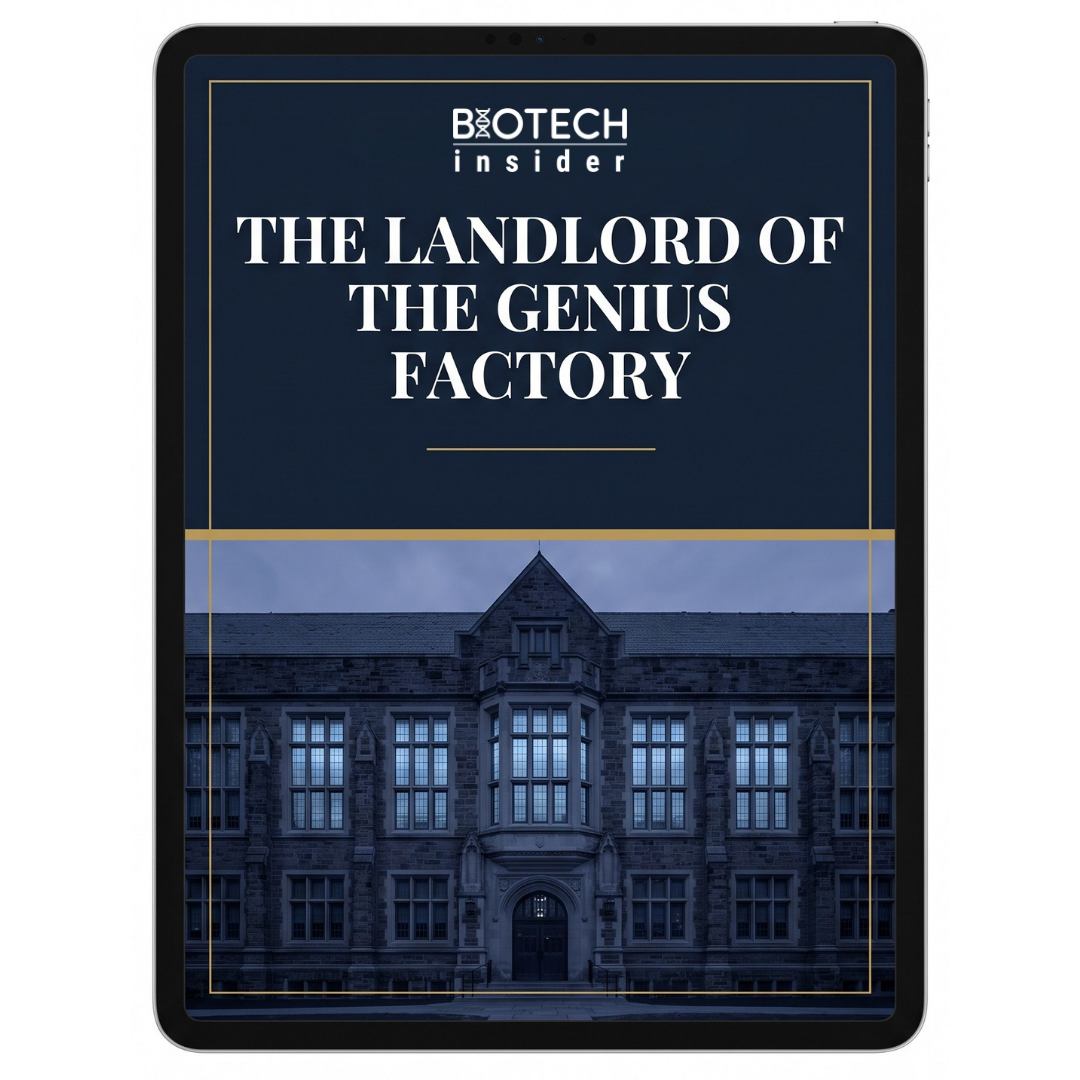
Think back to the first entry on the new workforce’s résumé — the machine mind that produced more science in a few months than fifty years of the world’s best-paid scientists.
Now let me tell you what I left out. That lab doesn’t belong to itself. It has an owner.
A landlord that collects on every discovery its machine minds produce — and that paid so little for it, back before anyone understood what was coming, that the purchase barely made the news.
And here is the part that matters to you: Wall Street still files this owner under a business that has nothing to do with any of it. The genius factory doesn’t show up on the ticker.
Which means the landlord trades today, in my judgment, as if the most productive laboratory of the century barely exists on its books.
The full story — who owns it, what its machine minds are being aimed at next, and my buy-up-to price — is in your second report.
What Happens the Moment You Join
When you click the button below, you’ll land on a secure order page that takes about two minutes to complete.
The instant it’s done, “The New American Workforce” is in your inbox and on your member dashboard — name, ticker, buy-up-to price, all of it.
Both bonus briefings arrive alongside it.
Your model-portfolio access is live the same minute, so you can see every open position — including the ones I showed you earlier — at their current prices, not a marketing snapshot.
No waiting for a welcome kit.
No “allow 6 to 8 weeks.” The switch I’ve been describing has flipped; your access flips in minutes.
What It Costs — and What It Doesn’t
Let’s tally what’s on the table, because I want the arithmetic in front of you before the price is.
You’re receiving the complete Synthetic Employer briefing — name, ticker, evidence trail, buy-up-to price, and the milestone calendar.
You get “The Checkpoint Stock” — the gate every synthetic worker’s traffic must clear, still priced like plain internet plumbing.
You’re receiving “The Landlord of the Genius Factory.”
And you’re receiving a full year of Biotech Insider — 12 monthly investment ideas, the complete model portfolio, and every alert I send, the moment I send it.
Research houses charge professionals thousands of dollars a year for institutional coverage that never once mentioned what you’ve read in this letter.
I’ve had readers tell me a single one of our defense recommendations paid for a decade of membership.
Your price for all of it — everything above — is $1,997. A full $1,000 off the regular $2,997 rate, through this presentation.
That’s $5.47 a day.
Less than the cup of coffee itself, for the research desk that put its readers into defense stocks in June 2001.
Crown briefing · 2 bonus reports · 12 issues · model portfolio · trade alerts
That’s $5.47 a day. Less than the cup of coffee itself, for the research desk that put its readers into defense stocks in June 2001. And if the Synthetic Employer does even a fraction of what the ladder companies did for their early investors, it may be the best-leveraged $1,997 you ever spend.
And I don’t want you to worry about that $1,997 today.
Your membership is protected by our 100% money-back guarantee: take the next 30 days to go through everything, follow the recommendations, and judge the results.
If Biotech Insider isn’t for you — for any reason, or none — a single call to my team gets you a full refund of your membership fee.
The reports are yours to keep either way.
I can’t make it safer to find out.

Take the next 30 days to go through everything, follow the recommendations, and judge the results. A single call to my team gets you a full refund. The reports are yours to keep either way.
The Two Kinds of People Reading This Letter
In a few seconds, you’ll do one of two things — and I’ve been writing letters like this long enough to know exactly how it goes.
Some readers will close this page.
Not because they disagree — almost nobody who reads this far disagrees — but because acting feels riskier than waiting.
They’ll bookmark it. They’ll “watch the stock.”
And in a year, when the synthetic workforce is a CNBC segment and the quiet company isn’t quiet anymore, they’ll remember this message the way people remember the stocks they should have bought… the ones they kick themselves for delaying on.
The Microsofts. The Nvidias. The Metas. The Apples.
The cost of that path is invisible today.
It always is.
And some people will do what the cab driver did in 1942: make a modest, deliberate move to the collecting side while the collecting side is still cheap — then go on about their lives while the law does what it has done without fail for 236 years.
A cup of coffee a day decides which one you are.
Two Verdicts
Let me leave you where we started — with Samuel Slater, and the two names history gave him.
In Belper, the town whose spinners lost their wages to his machinery, they called him Slater the Traitor. They said it for the rest of his life.
In Washington, the President of the United States called him the Father of the American Industrial Revolution.
A traitor, and a father. The same man. The same machinery. The only difference was where the judges stood — inside the pool, or on the collecting side.
236 years later, the same two verdicts are being handed out again, all around you, at software speed.
The employees of Automation Week received one of them. The shareholders received the other.
And the law behind it all — the law that turned a cab driver’s $1,000 into $2 million, that made millionaires of gofers and secretaries and a masseuse, that has never once failed to move the money from the paycheck side to the owners’ side — has already chosen its next collector.
The confession is on the record. The switch has flipped.
And the second wave is already on the calendar for November.
The confession is on the record. The switch has flipped.
The law… has already chosen its next collector.
The only question left is entirely, personally yours:
When your grandchildren ask where you were standing when the wealth started moving… which side of the machinery will your answer put you on?
Join me on the collecting side. Click the button below — your copy of “The New American Workforce” is waiting.
The buck stops here,
 Dylan JovineFounder, Behind the Markets